Primary and secondary schools in Luxembourg: choosing one and enrolling your child
39 days left
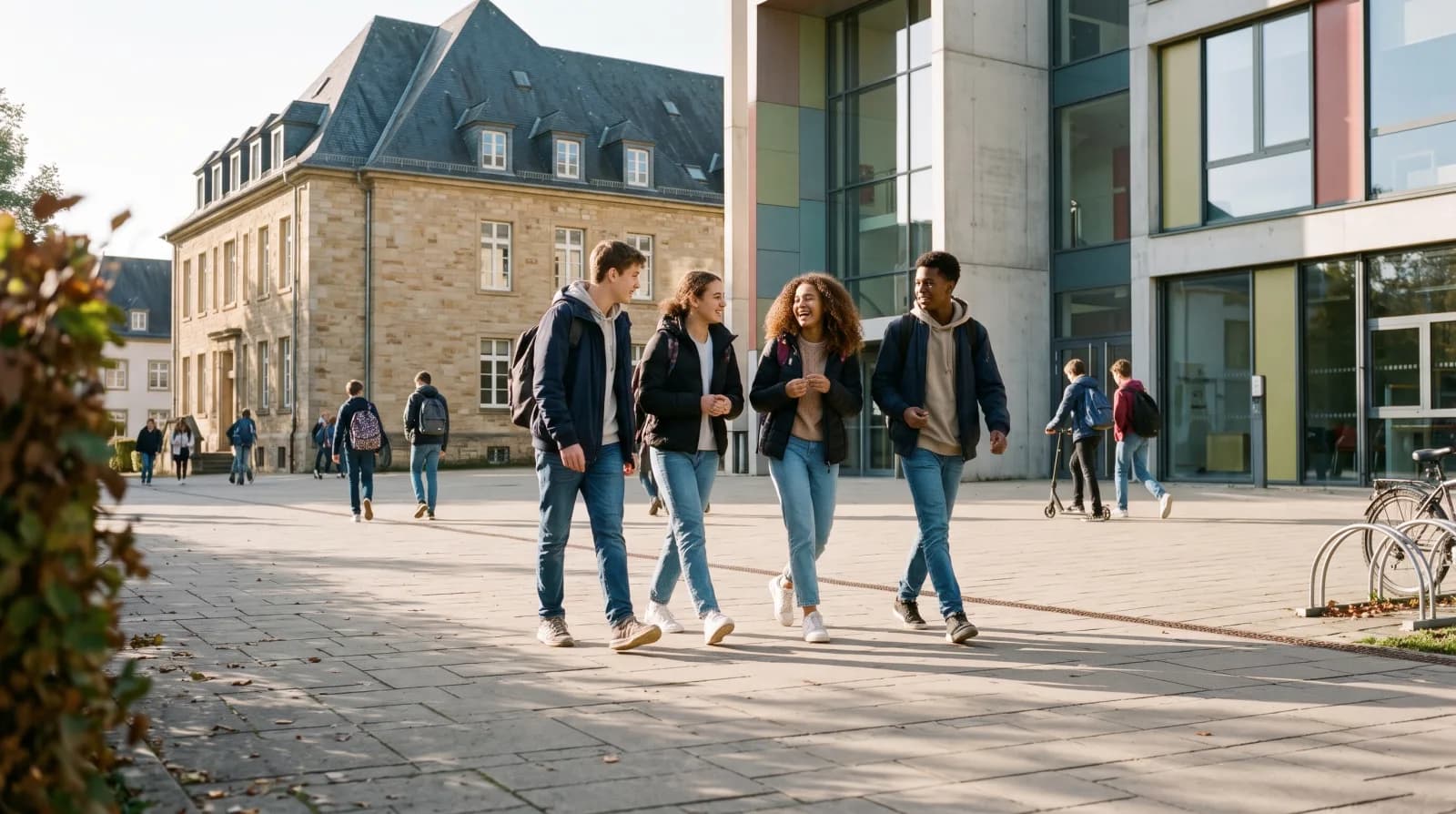
In Luxembourg, your child can go to a Luxembourg public school, a public European school, one of the two European Schools or a private international school. This guide helps you choose in six questions, then gives you the school directory and the steps to take.
Information in force as of 18 November 2026.

Skimming?
We've prepared the shortcut for you.
School is compulsory from age 4 (having turned 4 before 1 September) and, since the start of the 2026/2027 school year, it is gradually being extended up to age 18. Luxembourg public school is free for a child who lives in Luxembourg; it teaches in Luxembourgish, German and French. If you are a cross-border worker, your child has no automatic right to a place there (details in the frequently asked questions). If your child does not speak these languages, the six public European schools are free too and lead to the European Baccalaureate. The two European Schools (Kirchberg, Bertrange) take the children of European institution staff first; the others pay a tuition fee (5,913.21 € in primary in 2026-2027). Private international schools cost from 4,549 € to more than 24,000 € per year. Watch the dates: most public European schools take enrolments from 1 to 15 March. Answer the six questions in the module below to find out which school to aim for, then open its entry in the directory.
This is for you if
You are arriving in Luxembourg with a child and you don't know which school to choose.
Your child speaks neither German nor Luxembourgish.
You are hesitating between a free public European school, a European School and a private school.
You are a cross-border worker and you wonder whether your child can go to school in Luxembourg.
you are looking for a crèche or a maison relais for a child under 3: see instead our guide to the crèche and the chèque-service accueil.
The school directory
The 25 European, public international and private schools on the ministry's list, to filter by type of school, language, diploma and level, with for each one the municipality, the published fees, admission and the official link.
The differences, in plain terms
| Type of school | What it costs | Languages and diploma |
|---|---|---|
| Luxembourg public school | Free if you live in Luxembourg | Luxembourgish, German, French; secondary school leaving diploma |
| Public European school (6 schools) | Free | French, English or German section; European Baccalaureate |
| Public international secondary school (lycée) | Free if you live in Luxembourg | IB in English or in French, Cambridge (A-levels) in English |
| European School (Kirchberg, Bertrange) | Free in category I, paid by the employer in II, from 4,300.47 € to 8,063.46 € in III | Sections in many EU languages; European Baccalaureate |
| Private international school | From 4,549 € to more than 24,000 € per year | English, French or bilingual; IB, A Levels, French baccalauréat |
Good to know: in a public European school, the section depends on your child's dominant language, not on your choice, and it is the head teacher who sets it. One idea: if you are staying a long time and your child is young, Luxembourg public school gives them the country's three languages; if you are staying a few years, a public European school saves them from starting all over again in a new language.
On the budget side: also look at what you are entitled to with family allowance and the back-to-school allowance.
Sources: MENJE, international offer (opens in a new tab), MENJE brochure (2026) (opens in a new tab), Eurydice (opens in a new tab), European Schools admission rules 2026-2027 (opens in a new tab), tuition fee 2026-2027 (opens in a new tab).
Enrolling your child
Practical guide · trigger.lu
Primary and secondary schools in Luxembourg: choosing one and enrolling your child
- Deadline
- from 1 to 15 March in most public European schools
- European Schools
- dates for the 2027 intake not yet published; previous campaign from 2 to 27 March 2026
Details
Places go early. As of 18 November 2026, the two European Schools have not yet announced their enrolment period for the 2027 intake: keep an eye on their pages (Luxembourg I (opens in a new tab), Luxembourg II (opens in a new tab)). For the other schools, check the period on the school's website (link in the directory).
- Where
- 29, rue Aldringen, Luxembourg, (+352) 247-76570
- Bring
- identity document
- school reports for the last two years
- residence certificate if possible
Details
If your child is arriving from abroad, the ministry's school reception service enrols and guides them, from age 4. You can contact it before you arrive, with a form in 12 languages; it assesses their languages and what they have learned, proposes a class and follows them for two years. The documents listed are those required for a child aged 12 and over (MENJE (opens in a new tab)). Our guide explains how to get the residence certificate; if you have just arrived, start by declaring your arrival at the municipality.
- Deadline
- letter from the municipality by 15 April
- Bring
- family record book
- birth certificate
- enrolment form
Details
For public primary school (école fondamentale), the municipality automatically enrols your child in the school of their place of residence; you finalise it at the municipal secretariat (Guichet.lu (opens in a new tab)). Early education (éducation précoce) at age 3: make a written request before 1 April. Another public school: reasoned request before 1 May (Guichet.lu (opens in a new tab)), on one of the grounds set by the law of 6 February 2009 (opens in a new tab).
- Where
- directly at the school you have chosen
Details
Public European schools, European Schools and private schools take applications themselves: each entry in the directory gives the enrolment link.
- Bring
- enrolment certificate from the private school
Details
If your child goes to a private or international school, this certificate proves to the municipality that you are complying with compulsory schooling (Guichet.lu (opens in a new tab)).
Settling in Luxembourg for your child's schooling also means a home to find, insurance and a budget to review, on top of all the steps for settling in. To receive our next practical guides, sign up for the trigger newsletter.

The system in brief
- Primary school (ages 3 to 11): nine years in four cycles. Early education (age 3) is optional; school becomes compulsory once a child has turned 4 before 1 September (MENJE (opens in a new tab)).
- Secondary school (from age 12): seven years for a full course, in classic (ESC) or general (ESG) secondary education, or in the European, IB, Cambridge and German-Luxembourgish tracks (MENJE (opens in a new tab)).
- Languages: cycle 1 takes place in Luxembourgish with some French; after that, the child learns to read in German (MENJE, languages (opens in a new tab)). New in 2026/2027: for a child in cycle 1.2, you can choose French or German for learning to read, write and do arithmetic in cycle 2 (gouvernement.lu (opens in a new tab)).
- Compulsory schooling: gradually extended from 16 to 18 since the start of the 2026/2027 school year; this year, it applies to young people born after 31 August 2009. It ends earlier with a secondary school leaving diploma or a vocational training diploma, and a young person aged at least 16 with an employment contract is exempt (law of 20 July 2023 (opens in a new tab)).
Compared with France and Belgium: in France, education is compulsory from age 3 and up to 16, then you have to be in training up to 18 (Service-Public.fr (opens in a new tab)). In Belgium, it starts in the school year in which the child is 5 by 31 December at the latest and lasts until 18 (Fédération Wallonie-Bruxelles (opens in a new tab)). So a child arriving from France at age 3 does not have to go to school in Luxembourg before age 4, but can enter early education.
The international school in Mondorf
It has been taking pupils since 2018/2019 on a temporary site, and its classes P2 to P5 and S1 are shown as full (EIMLB (opens in a new tab)). On 15 October 2026, the Chamber adopted the bill that funds a new campus for 1,690 pupils with boarding facilities, due to open at the start of the 2031/2032 school year, subject to procedures (gouvernement.lu (opens in a new tab)).
What about university?
The University of Luxembourg is multilingual: each programme states its languages of instruction, and your child has to prove their level in each one. Admission, fees, State financial aid and housing: it is all in our guide Studying at the University of Luxembourg, and with a foreign school-leaving diploma, also think about getting the diploma recognised.
Frequently asked questions
Yes, for every child who lives in Luxembourg and is enrolled in a public school, the one in their municipality or another. The six public European schools are free too. Private schools charge fees, as do the two European Schools, except for the children of European institution staff (category I) and those whose employer pays for the schooling (category II).
Once a child has turned 4 before 1 September. Early education, from age 3, remains optional. Since the start of the 2026/2027 school year, compulsory schooling is gradually being extended up to age 18: this year it applies to young people born after 31 August 2009.
Make an appointment with the ministry's SIA, which assesses what they have learned and proposes a class. In primary, they follow an intensive welcome course on top of their class (MENJE (opens in a new tab)); in secondary school, they can join a welcome class or a French-speaking class (MENJE (opens in a new tab)). You can also aim for a public European school, where they learn in the section of their language (French, English or German).
Yes, in category III, depending on the places available: no pupil in this category joins a class of 27 pupils or more. The 2026-2027 tuition fee is 4,300.47 € in nursery, 5,913.21 € in primary and 8,063.46 € in secondary.
They have no automatic right to a place in public primary school: the law organises it for the child who lives in the Grand Duchy, in their municipality of residence (law of 6 February 2009 (opens in a new tab)). The six public European schools, which are free, are presented by the ministry as an offer “accessible to all residents” (MENJE (opens in a new tab)). The European Schools accept applications from families who do not yet live in Luxembourg, the Schengen-Lyzeum in Perl takes pupils from Germany and Luxembourg, and some private schools, which in principle require a home address in Luxembourg, look at other situations depending on places. Contact the school or the municipality you have in mind.