Car accident in Luxembourg: the complete guide to react
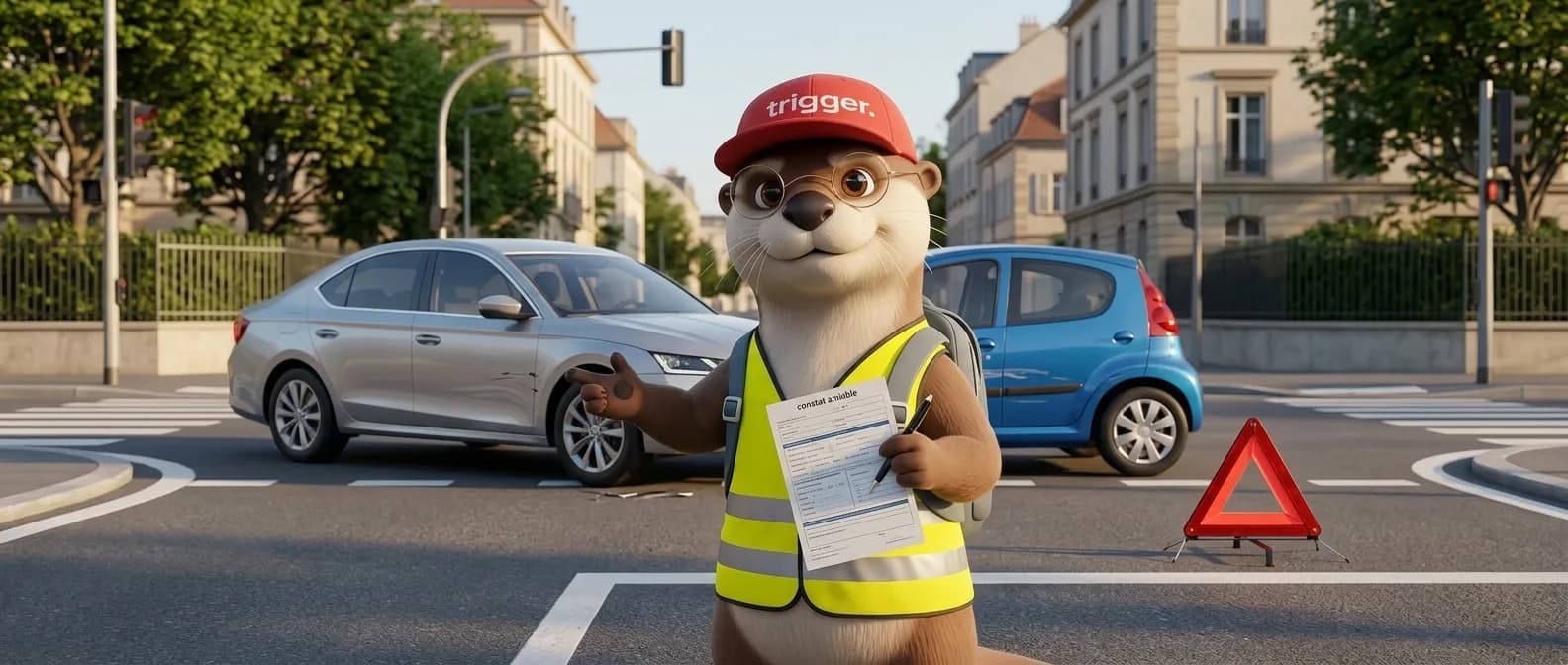
You've just had a car accident in Luxembourg and you're not sure what to do? Between the stress, the paperwork and the phone numbers to call, it's easy to feel lost. And if you're an expat, cross-border worker or newcomer, it's even more confusing.
Don't panic. We'll walk you through the whole process, from the moment of the crash to filing the claim with your insurer. Step by step, no jargon, no sales pitch.

Skimming?
We've prepared the shortcut for you.
First things to do at the scene
A car accident, even a minor fender-bender, triggers a spike of stress. Everyone goes through it. The key is to follow a logical order before diving into the paperwork.
Secure the area and check for injuries
First things first: put on your safety vest as soon as you step out of the vehicle (it's mandatory in Luxembourg), turn on your hazard lights, and place a warning triangle at a safe distance. If you're on a motorway, stay behind the crash barrier.
Check whether anyone is injured. If so, don't move them unless there's an immediate danger (car on fire, for instance). Keep them warm and reassured until help arrives.
Call for help
Two numbers to remember:
- 112: emergencies, ambulance, fire brigade. It's the single European emergency number, it works everywhere in Luxembourg.
- 113: Police Grand-Ducale. Call if there's a disagreement with the other driver, if there are injuries, or if you suspect a hit-and-run.
In practice, if the damage is only to the vehicles and both drivers agree on what happened, you don't have to call the police. But if the other driver refuses to fill in the report or disputes the facts, call 113 straight away.
Take photos before moving the vehicles
This is a reflex many people forget: photograph everything before moving anything. The position of the vehicles, brake marks, damage on each car, road signs, and the other vehicle's number plate. These photos can make a real difference when the claim is being assessed.
Once you've taken photos, clear the road if the vehicles can still drive. The Police Grand-Ducale recommends (ouvre dans un nouvel onglet) moving out of traffic and filling in the report somewhere safe, like a rest area or a car park.
Filling in the accident report without getting tripped up
The accident report (also called the European Accident Statement) is the most important document after a car accident. It's the basis on which insurers determine who's at fault. A poorly completed report can cost you, literally.
The same form is used across Europe. If the other driver is a cross-border worker or foreign national, each of you can fill in your section in your own language: the boxes are numbered identically.
What to check with the other driver
Don't just take their word for it. Ask to see and photograph:
- their ID (or driving licence)
- their green card (insurance certificate), which since January 2026 can also be shown on a smartphone
- their number plate (write it down immediately in case the other driver leaves)
In Luxembourg, the insurance certificate is not displayed on the windshield. It just needs to be kept inside the vehicle.
The boxes that change everything
The central column of the report (the "circumstances") is the most critical part. This is what insurers use to reconstruct the accident. A few classic traps:
- Box 8 "Was hitting the other vehicle in the rear" does not mean you were hit from behind. It means you hit the other vehicle in the rear. Read each label carefully.
- If you were driving normally with no particular manoeuvre, don't tick any box in the circumstances column. It's counterintuitive, but it's best practice.
- In a chain collision, fill in two separate reports: one with the vehicle in front of you, one with the vehicle behind.
- Write in the total number of boxes ticked in the space provided.
The sketch (box 13) matters just as much. You don't need to be an artist: just draw the road, signage, car positions and direction of travel.
Don't sign if you disagree
This is fundamental. By signing the report, you're acknowledging everything on it, including what the other driver wrote. Luxembourg courts treat the accident report as an extrajudicial admission. In plain terms: there's no going back once it's signed and the copies are separated.
If you disagree with the other driver's version, you have every right not to sign. Write your observations in box 14, keep your copy and send it to your insurer along with your photos.
One tip: use a ballpoint pen and press hard enough for both copies to be legible. No pencil, no felt-tip.
Do you need to call the police?
The short answer: not always. If the damage is only to property and both drivers agree on what happened, the accident report is enough.
You should call the police (113) in these situations:
- there are injuries (the police are then required to file an official report)
- the other driver refuses to fill in the accident report or disputes the facts
- you suspect the other driver is under the influence of alcohol or drugs
- the other vehicle isn't insured or the driver doesn't have a licence
- the other driver has fled the scene (hit-and-run)
- there's damage to public property (road signs, crash barriers, street lights)
Even if the police are called, you still need to fill in an accident report. Leaving the scene without doing so can be treated as a hit-and-run.
Filing the claim with your insurer
Once the report is done and the immediate situation is handled, you need to notify your insurer. Don't delay: the deadlines are tight and missing them can have serious consequences.
The deadline you can't miss
You have 5 working days to send the accident report to your insurer. For the claim itself, the deadline varies by company: 5 to 8 days as a rule. Some Luxembourg insurers allow 8 days.
The clock starts from the moment you become aware of the incident, not the date of the accident. But in practice, file as soon as possible.
How to file
Depending on your insurer, you have several options:
- via your company's mobile app (most Luxembourg insurers offer one)
- by phone to your agent or the claims department
- in person at your agent's office
- by registered post if you want a formal paper trail
Your insurer's number is on your green card, on your policy, and in your company's app.
Third-party, partial Casco, fully comprehensive: what changes
The type of cover you have determines what's covered:
Third-party liability (RC) is mandatory in Luxembourg. It covers the damage you cause to others but not the damage to your own vehicle.
Partial Casco covers additional risks on your vehicle (theft, broken glass, fire, hail, collision with an animal) but not accidents you caused.
Fully comprehensive (Casco complète) also covers damage to your own vehicle, whether you're at fault or not. If you're not at fault, your insurer will claim back from the other party's insurer. The advantage: you're compensated quickly without waiting for the other side.
One important point: contact your insurer before getting your vehicle repaired. If you start repairs without prior approval, your compensation could be refused.
Special cases
Accident with a foreign or cross-border vehicle
With over 200,000 cross-border workers commuting to Luxembourg every day, collisions with vehicles registered in France, Belgium or Germany are common. The procedure is the same: fill in the accident report and send it to your insurer.
The European Accident Statement is identical in every country. Each driver fills in their column in their own language, the boxes are numbered the same way. Your insurer will contact the representative office of the other party's insurer in Luxembourg.
Good to know: the compensation process can take longer in this case. The other party's insurer has 3 months to issue an initial response.
Hit-and-run: what to do when the other driver leaves
Every year, over 2,400 hit-and-runs are recorded in Luxembourg. It's a serious offence punishable by 8 days to 3 years in prison, a fine of 500 to 10,000 EUR and a driving ban of 3 months to 15 years.
If the other driver flees:
- write down the number plate immediately (or any useful detail: colour, model, direction)
- call the police on 113 and file a complaint
- notify your insurer
- never just leave a note on the windshield if you've damaged a parked vehicle: the police recommend calling them straight away
Without fully comprehensive insurance, if the responsible party isn't found, you may have to pay for repairs out of your own pocket. Something to keep in mind when choosing your cover.
Your vehicle is a write-off
If your vehicle is declared beyond repair after the accident, you must notify the SNCA (ouvre dans un nouvel onglet) (Société Nationale de Circulation Automobile) within 5 working days, by registered post or by going to their counter in person. In some cases, your insurer can handle this for you.
The number plates must be destroyed unless you transfer them to another vehicle in your name.
Outside traffic, it's your private liability insurance that steps in.
Useful contacts in case of an accident in Luxembourg
So you have everything at hand when it matters:
Emergencies: 112 (ambulance, fire brigade, emergencies) and 113 (Police Grand-Ducale)
Police Grand-Ducale: police.public.lu (ouvre dans un nouvel onglet) - contact in case of injuries, refusal to fill in the report, hit-and-run or dispute
SNCA (vehicle registration and traffic): snca.public.lu (ouvre dans un nouvel onglet) - for licence plate formalities, official documents and write-offs
Main hospitals:
- Centre Hospitalier de Luxembourg (CHL): +352 4411 11
- Hôpitaux Robert Schuman (HRS): +352 2468 1
Your insurer: the number is on your green card, in your company's app or on your policy

Frequently asked questions
Not necessarily. The Police Grand-Ducale actually recommends against it if the location is dangerous (motorway, busy junction). Take photos, note the other vehicle's plate number, then move to a safe spot to complete the report.
You have 5 working days to send the report. For the full claim, the deadline is 5 to 8 days depending on your insurer. Best practice is to file on the same day or the next, while the facts are still fresh.
It's a criminal offence. Penalties range from 8 days to 3 years in prison, a fine of 500 to 10,000 EUR, a driving ban of 3 months to 15 years and 4 penalty points. Leaving the scene without filling in a report can count as a hit-and-run, even if you didn't cause the accident.
The other driver's third-party insurance covers your material and bodily damage. But the process can be slow: your insurer has to claim from the other party's insurer. If you have fully comprehensive cover, you're compensated directly by your own company, which then recovers the costs.
The procedure is the same: accident report, photos, notify your insurer. The European Accident Statement is identical in every country. The difference is that the compensation timeline can stretch to 3 months or more while the representative bureaux communicate.